Book Review
by Russell Jaslow
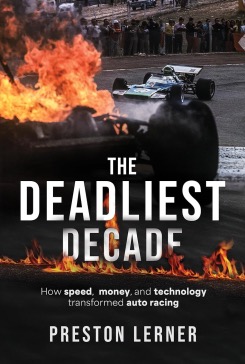
Deadliest Decade - How speed, money, and technology transformed auto racing
by Preston Lerner
Octane Press
ISBN: 978-1-6423-4184-3. List Price: $39.95.
 Many years ago, a former co-worker (and current friend) who was also an avid auto racing fan, once remarked to me, "I can't believe the sport ever survived the 60s." He was referring specifically to how dangerous the sport was at the time and how many drivers (not to mention spectators and workers) who were killed during that time. How the sport didn't implode, or get outright banned, under that trail of blood astounded him. Many years ago, a former co-worker (and current friend) who was also an avid auto racing fan, once remarked to me, "I can't believe the sport ever survived the 60s." He was referring specifically to how dangerous the sport was at the time and how many drivers (not to mention spectators and workers) who were killed during that time. How the sport didn't implode, or get outright banned, under that trail of blood astounded him.
In the Deadliest Decade, Preston Lerner deals with that subject. He states right up front that from 1964-1973, over 1,400 fatalities were recorded throughout the world in all forms of racing, the deadlest 10-year span in auto racing's history. Now, think about that for a second. Assuming these numbers are spread out evenly (admittedly a big assumption), that's 140 deaths per year. Which means that every weekend of competition, almost three people died. For 10 years. No wonder my friend is amazed the sport survived that time period.
This book is not about rehashing in all their gory details every historic or significant deadly crash. The book is really about what the subtitle states -- How speed, money, and technology transformed auto racing. Or, to put it in Lerner's own words, "From the beginning, my goal has been to come up with what Einstein called a unified field theory to comprehensively explain the revolution that occurred in the motorsports world from the mid-1960s to the mid-1970s."
Though Lerner acknowledges Einstein failed in his attempt, I believe Lerner is successful on this subject. Brilliantly successful. Not just because Lerner is a career journalist, so he knows how to properly research and fact check a project (17 pages of endnotes attest to this, not to mention some of the interviews are with people who died a few years ago, so this was a long-term project). And not just because he is an excellent writer.
I have always maintained that you can't properly tell the history of a large topic in a broad manner. Unless you are going to produce multiple volumes, and even then people will lose interest. Some of those attempts simply end up as a coffee table book, which at times serves a purpose. However, if you pick a single subject of the topic and then delve deeply into it, you can produce an interesting, detailed, scholarly, historical account. This is why Lerner was successful reaching his goal.
The book may be looking at the deadliest decade, but by delving into that particular subject, Lerner provides an overall history of the sport which led us to the horrifying safety record and then the changes the sport made to make it safer than it's ever been.
Money, mainly thanks to cigarette advertising discovering the sport at the same time TV started to cover it extensively, enabled technological advances which exponentially increased speeds in 10 years, when the previous 10 years they barely changed. (Not to mention the intense tire war between Goodyear and Firestone.)
Lerner touches on all aspects of the sport -- Indy cars, F1, NASCAR, sports cars, drag racing, short track racing, and so forth. He writes about the insane safety shortfalls (guardrails not even mounted in the ground, trees smack in the middle of runoff areas, even trees in front of the guardrail; total insanity when you think about it), the attitudes of the time (if you're worried about hitting something, don't crash), and the absurd lack of rescue and medical support.
He includes some of the pivotal moments to get sanctioning bodies to change their ways (such as Lorenzo Bandini at Monaco, Roger Williamson at Zandvoort, the 1973 Indy 500) as well as the key turning points in providing safer ways (such as Jackie Stewart's crusade, Bill Simpson's fire proof suits, the Snell Foundation, the interesting history behind fuel cells). There will be people and events along the way which I can guarantee you have never heard about before. [And as a special bonus, Lerner finally answers the question on who actually wrote the famous there are only three sports quote.]
When you are done, you, too, will wonder what my co-worker wondered -- how did this sport survive? But even more disturbing, there are still people who fight safety initiatives (look at the outcry over the halo in F1 or the HANS device even after Earnhardt's death) or who, for some unknown reason, wax wishfully for the old days of danger and daring.
This is a book that is a must for any racing fan, old or new, to understand the transformation of the sport from the early days to the deadliest decade to the mega business and hugely popular, and considerably safer, sport it is today. All due to speed, money, and technology.
Copyright © 2026 by . All Rights Reserved.
|




 Site Index |
Search |
Contacts |
Ad Rates |
Site Index |
Search |
Contacts |
Ad Rates |